

Who can use permissive mode
Permissive mode is available to customers who have at least one tenant with third-party applications before April 2026. All tenants under that customer’s account can create permissive third-party applications, even tenants that did not previously have third-party applications. These customers can:- Continue operating pre-existing third-party applications with their current behavior
- Create new third-party applications with
third_party_security_mode: "permissive"via the Management API - Create new applications with enhanced security controls at any time
What permissive mode means
Third-party applications in permissive mode behave similarly to first-party applications in terms of available features:- Most grant types are available (authorization code, implicit, client credentials, device code)
- OIDC scopes and ID tokens are supported
- API access follows the API’s configured access policy (not forced to require a client grant)
- Standard Client ID format (no
tpc_prefix) - All client properties can be configured
- Configuring API access policies on each API to control which third-party applications can access them
- Reviewing which grant types and features are enabled for each application
- Monitoring third-party application behavior through tenant logs
The third_party_security_mode property
Every third-party application has a third_party_security_mode property that indicates its security mode. This property is set at creation and cannot be changed.
Third-party applications created before the introduction of security modes return
third_party_security_mode: "permissive" in API responses.
Feature comparison
Dynamic Client Registration in permissive mode
If your account is eligible for permissive mode and you use Dynamic Client Registration, you can control the security mode for dynamically registered clients with a separate tenant setting.- Auth0 Dashboard
- Management API
- Navigate to Settings > Advanced.
- Under Dynamic Client Registration (DCR) Security Mode, select Permissive.
- Select Save.
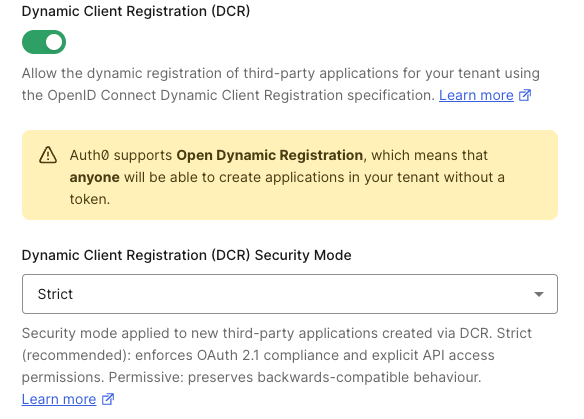
dynamic_client_registration_security_mode setting is independent of the default for applications created via POST /api/v2/clients. You can configure it at any time.
Adopt enhanced security controls
Auth0 recommends adopting enhanced security controls for all new third-party applications. Thethird_party_security_mode property cannot be changed after an application is created — you cannot convert an existing permissive application to strict, or vice versa. Instead, you choose which security mode to use when creating new applications going forward.
To understand how the default for new applications is changing and how to prepare, read Migrate to Enhanced Security for Third-Party Applications.
If you need to replace an existing permissive application with a strict one, you must create a new application. This invalidates all existing refresh tokens and user grants for the old application. Coordinate the cutover with the external party to minimize disruption.